Civil service study guide
Last reviewed: August 5, 2026
Reviewed by CivilServiceExam.org Editorial Team
911 Dispatcher
Prep for public safety dispatcher and emergency communications titles.
Complete prep bundle
Want the full 911 Dispatcher study system?
This free guide explains the exam. The premium bundle adds the longer drill sets, answer explanations, structured study plan, and print-ready materials candidates use to turn weak spots into score gains.
Overview
911 Dispatcher and public safety telecommunicator exams measure the specific skills the job demands: absorbing information quickly, holding several facts in mind at once, and making sound decisions under time pressure.
Our guide focuses on the exam categories candidates actually face—reading comprehension, memory and observation, multitasking, data entry, map reading, and situational judgment—rather than on prior dispatch experience you are not expected to have.
Many dispatcher exams present short scenarios in which a caller reports an emergency. You are asked to identify the most important information, the correct order of actions, or the appropriate response—applying the procedure described in the question, not outside knowledge.
Memory and recall sections are common: you may study a page of call details, addresses, or a dispatch log, then answer questions after the material is removed. This is a learnable skill that rewards structured practice.
Speed and accuracy on keyboarding and data entry are frequently timed and scored separately. If your announcement includes a typing or coding component, practice on the same keyboard layout you will use on test day.
Across all sections, the exam rewards composure. Candidates who lose accuracy when several tasks compete for attention are exactly what these tests are designed to screen for—so practicing under realistic time pressure matters as much as content review.
The merit system
Under the merit system, your competitive exam score is the primary basis for placement on the eligible list for dispatcher and telecommunicator titles. Small gains in accuracy and pacing can move you meaningfully up the list.
Dispatcher hiring is usually multi-stage: the written exam establishes your rank, and later steps—typing tests, background checks, hearing and voice screening, and oral interviews—follow for candidates reached from the list.
Eligible lists are typically certified for one to four years depending on jurisdiction. Respond promptly to any canvass or notification, since missing the window can remove you from consideration despite a strong score.
Veterans and residency credits are added to passing scores, not failing ones, and vary by jurisdiction. Confirm how your agency calculates final standing before you assume credits will offset under-preparation.
What these exams typically test
Civil service written tests usually measure more than raw subject recall—they test how you apply rules, prioritize, and work under time pressure.
- Reading comprehension of procedures, call scripts, and policy passages.
- Memory and observation: recalling addresses, names, and call details studied earlier.
- Multitasking: tracking and prioritizing several pieces of information at once.
- Situational judgment: choosing the correct response and order of actions in an emergency.
- Data entry and keyboarding accuracy, often timed and scored separately.
- Map reading and directional reasoning: locating an address or routing a unit.
- Basic arithmetic and number reasoning when specified in the announcement.
- Emergency communications: identifying the most critical information from a caller.
- Following written protocols step-by-step without skipping or reordering.
- Customer service and professional composure in high-stress interactions.
Topic checklist
- Emergency call handling and prioritization
- Memory and observation drills for addresses and call details
- Multitasking and information-tracking scenarios
- Map reading, grid coordinates, and directional awareness
- Data entry speed and accuracy under a time limit
- Situational judgment for police, fire, and EMS calls
- Reading comprehension of dispatch procedures and policy
- Radio and phonetic alphabet familiarity
- Customer service and de-escalation basics
- Exam-specific weights and typing requirements — cross-check your official announcement
How to prepare
- Practice reading comprehension daily with dense, procedural text so you can locate a specific detail—an address, a code, a required action—quickly under time pressure.
- Build memory skill deliberately: study a list of 15–20 call details or addresses for two minutes, cover it, then answer from memory. Track your accuracy as it improves week over week.
- Train multitasking by listening to a recorded scenario while logging key facts (location, callback number, nature of the emergency), then answering questions about what you captured.
- Work through situational judgment items and, for each, explain why the correct answer follows the procedure in the scenario—especially the correct order of actions when seconds matter.
- Practice data entry and keyboarding on a standard layout with a timer, focusing on accuracy first; most scoring formulas penalize errors more heavily than incomplete entries.
- Complete map-reading exercises: locate an address on a grid, follow a described route, and identify the fastest direction of travel from a written dispatch.
- Take at least two full-length timed practice sessions before test day to build endurance and identify which categories cost you the most points.
Common mistakes to avoid
- Answering situational judgment items from instinct instead of the protocol stated in the scenario. The exam supplies the governing procedure—apply it, including the required sequence of actions.
- Treating the memory section as untrained recall. Structured, repeated practice reliably raises scores; this is a skill, not a fixed trait.
- Losing accuracy when tasks pile up. The multitasking sections are designed to expose this—practice capturing information calmly rather than trying to hold everything in your head.
- Rushing the data entry section and accumulating avoidable errors. Steady, accurate keying usually beats fast, error-prone keying under the scoring formula.
- Skipping the map and directional section because it feels unfamiliar. A few hours of targeted practice closes most of the gap.
- Ignoring the official exam announcement. Categories, weights, and typing requirements vary by jurisdiction; preparing for the wrong mix is a preventable mistake.
Exam day strategy
- Read each scenario fully before the answer choices. Identify the most critical information and the required first action before weighing options.
- For memory sections, scan in a deliberate pattern—categorize what you see (locations, names, numbers, actions) and review each category in order before the material is removed.
- When a call scenario conflicts with your general knowledge, follow the procedure in the passage. The exam tests whether you can apply the stated protocol, not prior experience.
- On data entry, prioritize accuracy over raw speed unless the instructions explicitly reward volume—verify critical fields like addresses and callback numbers.
- Flag any item taking longer than about 90 seconds and return to it. On timed multitasking sections, protecting your pace prevents one hard question from costing several easy ones.
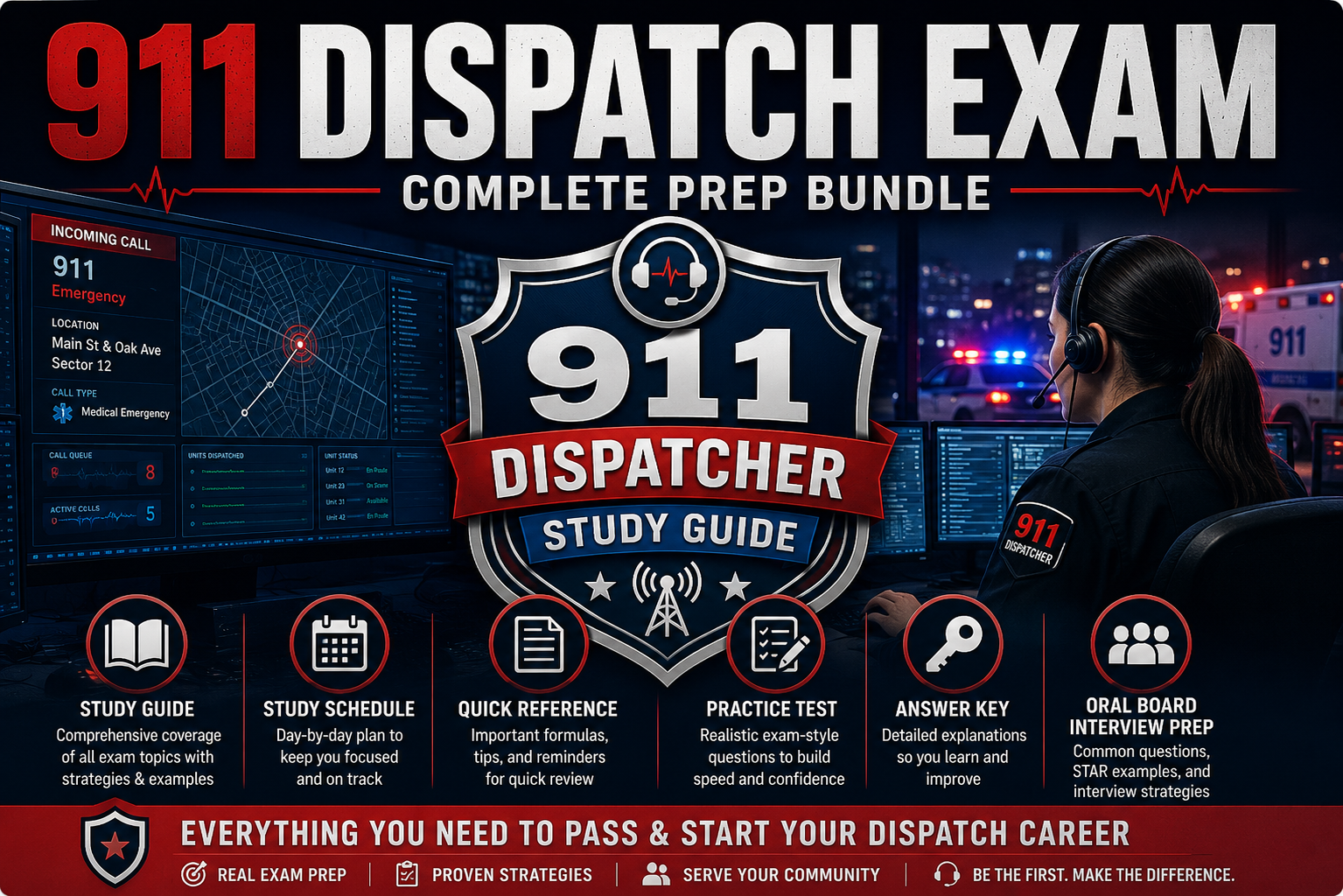
Premium PDF Bundle
911 Dispatcher Exam Prep Bundle — $12.99
6 resources, 200 practice questions, a 30-day study plan, and bonus interview prep — built as a complete score-improvement system.
- ✓RESOURCE 1 — Complete 911 Dispatcher Study Guide: Comprehensive coverage of Reading Comprehension, Memory & Observation, Multitasking, Data Entry & Keyboarding, Map Reading & Directional Awareness, Situational Judgment, Customer Service, Emergency Communications, and dispatcher fundamentals. Includes practical strategies, worked examples, and practical test-taking techniques.
- ✓RESOURCE 2 — Practice Test: A realistic 911 Dispatcher exam-style practice test covering every major topic to simulate timed testing conditions.
- ✓RESOURCE 3 — Answer Key & Detailed Explanations: Every practice question includes detailed explanations so you understand not only the correct answer, but also why the other choices are incorrect.
- ✓RESOURCE 4 — 30-Day Study Schedule: A structured day-by-day study plan with a condensed two-week version for candidates with upcoming exam dates, timed drills, review sessions, and a full mock exam schedule.