Exam type
Varies by agency
Core skills
Speed, accuracy, filing
Common roles
Clerical and office support
How the Exam Works
Clerical civil service exams are usually designed around practical office skills rather than specialized professional knowledge. A city, county, or state agency may test a different combination of subjects, use a timed computer assessment, or include education-and-experience review. Read the official announcement for the actual subjects, scoring, timing, and calculator rules.
The most common mistake is practicing only for correctness. Many clerical assessments also reward efficient, consistent work, so preparation should include short timed drills followed by careful error review. Build accuracy first, then shorten the time target gradually.
What the Exam Tests
These are common clerical preparation areas. Your announcement may combine them, rename them, or test a different set of office skills.
Speed & Accuracy
Compare names, numbers, codes, and records carefully while maintaining a sustainable pace.
Alphabetizing & Filing
Practice the filing convention stated in each question; rules can differ across tests and workplaces.
Reading Comprehension
Identify instructions, details, exceptions, and the best-supported conclusion from workplace passages.
Written Expression
Review spelling, grammar, punctuation, sentence clarity, and professional tone.
Basic Arithmetic & Office Math
Work with totals, balances, percentages, fractions, and everyday office calculations.
Office Procedures & Records
Practice organizing information, following procedures, handling records, and choosing the next appropriate step.
Everything You Need to Prepare
Use these verified bundle components as a simple preparation checklist: practice the relevant skills, review your mistakes, and follow a structured plan before exam day.
Practice Questions
Exam-style questions covering every major tested category, plus a full-length timed mock exam.
Detailed Explanations
Understand why each correct answer is right: and why each wrong answer is wrong.
How Should You Practice?
There is no universal clerical passing score because agencies use different exams, scoring systems, and eligibility rules. A practice score is most useful as a category diagnostic: it shows whether errors come from misunderstanding, rushing, or inconsistent checking.
Keep a simple error log. Record the question type, the reason for the miss, and the faster checking habit that would have prevented it. That feedback loop is more useful than repeatedly taking the same untimed quiz.
Accuracy is the foundation; timed practice should make careful work faster, not replace it.
Complete prep bundle
$12.99
Clerical: Clerical Exam Prep Bundle
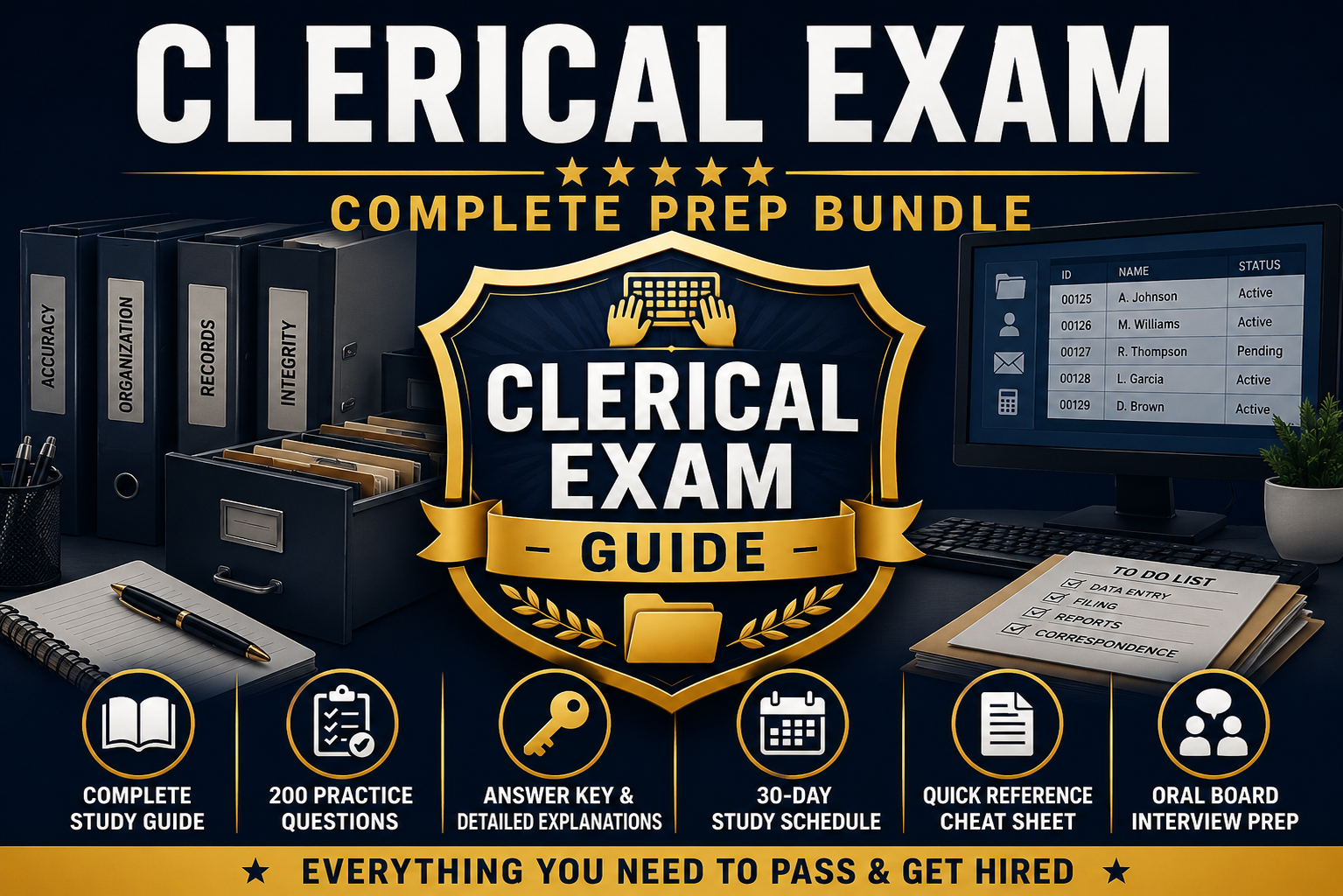
Six independent resources for speed and accuracy, filing, reading, writing, office math, records, 200 original questions, a four-week plan, and interview preparation.
- Practice Questions
- Detailed Explanations
Want ongoing practice instead of a one-time guide?
Pro builds a phased daily study plan from your weak areas, explains every question you miss, and adds up to 300 scored practice questions, flashcards, Ollie (your AI study coach), and an AI resume review for $14.99/month.
Frequently Asked Questions
What is on a clerical civil service exam?
Common areas include speed and accuracy, alphabetizing and filing, reading comprehension, written expression, basic arithmetic, and office procedures. The exact subjects and timing depend on the agency and exam announcement.
How can I improve my clerical exam speed?
Build accuracy with short untimed drills first, then add a time target. Review every error and identify whether it came from a rule misunderstanding, a reading mistake, or rushing.
Are calculators allowed on clerical exams?
Calculator rules vary. Check the current announcement or admission instructions for your exam rather than assuming a calculator is permitted.
Is this an official clerical exam guide?
No. This is independent supplemental preparation. The official announcement from your agency or testing provider controls the actual content, format, timing, and scoring.