Official title
Police Communications Technician
Exam authority
NYC DCAS
Work setting
Emergency communications
How the Exam Works
NYC DCAS describes Police Communications Technicians as 911 call-takers and radio dispatchers who obtain information, initiate emergency assistance, coordinate police resources, and handle related administrative work. The current Notice of Examination controls the education and experience requirements, testing dates, and official selection process.
The role requires more than fast typing. Candidates must listen carefully, enter accurate information, stay calm while callers are under stress, make responsible judgments when timing is critical, and work rotating tours. Practice should therefore combine accuracy with calm, structured decision-making.
What the Exam Tests
These preparation areas reflect the communication and cognitive demands described for the title. They are independent practice categories, not reproduced official questions.
Listening & Reading
Extract the essential facts from a caller statement, message, or written instruction without losing qualifiers.
Information Ordering
Organize facts, priorities, procedures, and response steps in the correct sequence.
Problem Sensitivity
Recognize when information indicates a risk, missing detail, or need for immediate escalation.
Judgment Under Pressure
Choose a calm, professional response that protects safety and follows the stated procedure.
Accuracy & Typing
Practice entering names, locations, numbers, and incident details without avoidable transcription errors.
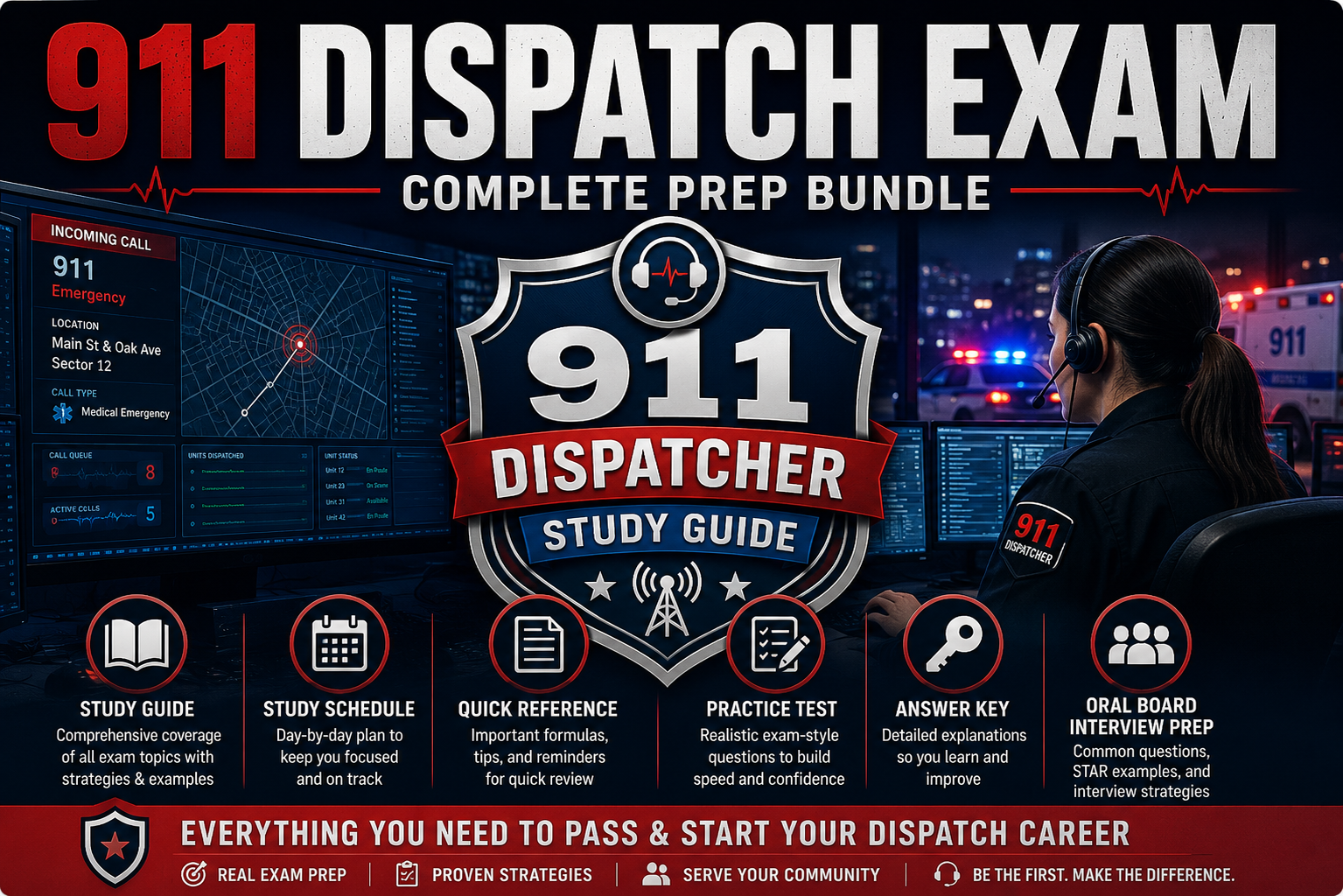
Everything You Need to Prepare
Use these verified bundle components as a simple preparation checklist: practice the relevant skills, review your mistakes, and follow a structured plan before exam day.
Detailed Explanations
Understand why each correct answer is right: and why each wrong answer is wrong.
30-Day Study Plan
A structured day-by-day schedule, with a condensed option for candidates testing sooner.
Role-Specific Prep
A full study guide built around this exam's tested categories, not generic test-prep material.
What Should You Practice?
The official exam notice controls the passing and ranking rules. Do not use an unofficial practice percentage as a hiring prediction. Instead, track whether your errors come from missing a detail, ordering steps incorrectly, or rushing a judgment decision.
Practice with realistic information density. Read or listen once, write down the essential facts, and then check whether your answer preserves the location, time, people involved, urgency, and requested action.
For emergency communications, accurate information and calm prioritization matter as much as speed.
Complete prep bundle
$12.99
NYC 911 Dispatcher: 911 Dispatcher Exam Prep Bundle
Independent 911 dispatcher practice for reading, listening, ordering, memory, judgment, 200 original questions, and a structured supplemental plan.
- Detailed Explanations
- 30-Day Study Plan
Want ongoing practice instead of a one-time guide?
Pro builds a phased daily study plan from your weak areas, explains every question you miss, and adds up to 300 scored practice questions, flashcards, Ollie (your AI study coach), and an AI resume review for $14.99/month.
Frequently Asked Questions
What is the NYC 911 dispatcher job title?
The NYC civil service title is Police Communications Technician. DCAS describes the role as including 911 call-taking, obtaining information, initiating emergency assistance, and dispatching police resources.
What skills should I study for the NYC 911 dispatcher exam?
Practice listening and reading accuracy, information ordering, problem sensitivity, judgment under pressure, memory, and careful data entry. Follow the current Notice of Examination for the official test description.
Does the NYC Police Communications Technician process include training?
The current DCAS notice describes required 911 emergency call-taker and radio dispatcher training courses. Review the current notice for the requirements tied to your exam cycle.
Is this an official NYC 911 dispatcher study guide?
No. This is independent supplemental preparation and is not affiliated with NYC DCAS, NYPD, or any emergency communications agency.